Boundaries with Teens : When to Say Yes, How to Say No by Dr. John Townsend
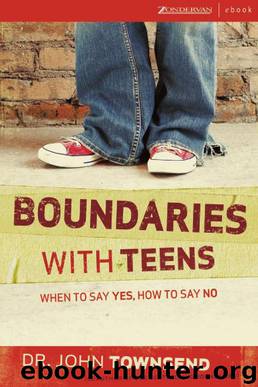
Author:Dr. John Townsend [Dr John Townsend]
Format: epub
Tags: General, Religion, Christianity, Christian Life, Christian Life - General, Christian life & practice, Life Stages, Family & Relationships, Christianity: General, Teenagers, Parenting, Religious aspects, Religion - Marriage & Family, Christian Life - Parenting, Child rearing - Religious aspects - Christianity, Teenagers: advice for parents, Teenagers - Conduct of life, Parent And Child, Parent and teenager - Religious aspects - Christianity, Parenting - General, Parent and teenager, Life Stages - Teenagers, Parenting - Religious aspects - Christianity, Child rearing
ISBN: 9780310259572
Publisher: Zondervan
Published: 2009-11-30T12:00:00+00:00
1. Not okay: substandard grades, which will involve a
consequence
2. Okay: acceptable grades, which will result in neither a consequence nor a reward
3. Excellent: indicating extra performance, which will involve a
reward
Then determine specific rewards and consequences for grades,
which can range from monetary and privilege rewards to consequences, such as loss of media, decreased social time, and increased
chores. Write down what you agree to, and post the list on the refrigerator. You may need to refer to this list often. Besides, when it’s in
plain view, your teen will be less likely to argue with you about those
rewards and consequences.
Academic Problems
145
Also let your teen know that good grades are important. For
example, say, “I know you don’t enjoy doing homework. It’s work,
and I didn’t like it either. But it is part of your responsibility, and I
expect at least okay grades from you. I want you to succeed, and I will
provide as much support as I can, but you must do the work.”
Most schools give progress reports halfway between either quarter
or semester reports. These reports give you objective information and
time to help your teen with subjects she may be struggling with.
If grades are a problem with your teen, she likely has an unrealistic view of her success and of what is required. So don’t believe her
perception that she has done her work or has studied enough. Check
it, check it, check it.
Establish a daily structure. If you find your teen doesn’t get to
homework until late or not at all, set up his after-school day so that
he has to get to his assignments early enough. For example, allow him
about thirty minutes to chill out when he gets home from school. Then
tell him it’s time to study. He can’t watch television, be on the phone,
listen to music, or play video and computer games until he has done the
work, including home chores. You want your teen to learn to postpone
having fun until after he has earned it. If he fools around and doesn’t
get to the homework until bedtime, it’s straight to bed when he’s finished. You are the guardian of the schedule and of his sleep routine.
Weekends should involve some study time too. Teens need weekends to relax and be with friends, but schools often assign homework
over the weekend. Remember there are two, not three, weekend nights.
Sunday is a technically a school night, so it’s not a late night.
You Can Do It!
If your teen needs a lot of structure, you may have to put more personal time into her studying than you thought. This may be difficult
if both parents work outside the home, if you are a single parent, or if
you have lots of kids. But even so, your teen’s needs don’t change. She
still needs people, support, and structure. Check with other sources,
such as the school, a church, or a tutoring service to see if they can
provide someone to help your teen stay on task. While a parent is
ideal, anyone caring and competent can help.
146
Boundaries with Teens
Finally, your teen’s lack of motivation or defiance may be beyond
your resources. If
Download
This site does not store any files on its server. We only index and link to content provided by other sites. Please contact the content providers to delete copyright contents if any and email us, we'll remove relevant links or contents immediately.
The 5 Love Languages: The Secret to Love That Lasts by Gary Chapman(9902)
The Space Between by Michelle L. Teichman(6976)
Assassin’s Fate by Robin Hobb(6297)
Wiseguy by Nicholas Pileggi(5841)
Everything Happens for a Reason by Kate Bowler(4784)
Gerald's Game by Stephen King(4709)
Pillow Thoughts by Courtney Peppernell(4328)
A Simplified Life by Emily Ley(4216)
The Power of Positive Thinking by Norman Vincent Peale(4102)
The Secret Power of Speaking God's Word by Joyce Meyer(3404)
Harry Potter and the Prisoner of Azkaban (Book 3) by J. K. Rowling(3394)
Resisting Happiness by Matthew Kelly(3369)
Girl, Wash Your Face by Rachel Hollis(3315)
Being Aware of Being Aware by Rupert Spira(3298)
The Code Book by Simon Singh(3252)
Real Sex by Lauren F. Winner(3060)
More Language of Letting Go: 366 New Daily Meditations by Melody Beattie(3057)
Name Book, The: Over 10,000 Names--Their Meanings, Origins, and Spiritual Significance by Astoria Dorothy(3008)
The Holy Spirit by Billy Graham(2999)
